How to Deploy on GIWA Testnet with WheelX
August 14, 2026
How to Deploy on GIWA Testnet with WheelX

GIWA describes itself as a builder-friendly Ethereum Layer 2. Its active test environment is connected to Ethereum Sepolia and is also called GIWA Sepolia, while GIWA Mainnet remains under development in the official documentation. For builders who want to test a simple on-chain action without configuring a full development stack, WheelX provides a one-click route: connect a wallet, select GIWA Testnet, approve the transaction, and verify the result in the explorer.
For users who do not want to prepare a development environment, WheelX provides a simpler path: connect an EVM wallet, choose GIWA Testnet, and initiate a smart-contract deployment without editing source code.
GIWA Sepolia at a Glance
GIWA Sepolia uses Chain ID 91342 and ETH for gas.
The standard RPC is https://sepolia-rpc.giwa.io, and the Flashblocks RPC is https://sepolia-rpc-flashblocks.giwa.io.
Both public endpoints are rate-limited and not intended for production. Transactions and contracts can be inspected through the https://sepolia-explorer.giwa.io/
ChainList independently lists GIWA Sepolia with Chain ID 91342, ETH, and the same explorer. It is convenient for wallet setup, but GIWA’s official documentation remains the authoritative source for network parameters.

WheelX’s GIWA Deployment Milestones
In a May 6, 2026 announcement, WheelX had helped users deploy more than 1 million smart contracts on GIWA Testnet.

In a July 25, 2026 update, WheelX reported more than 1.5 million deployments, with growth exceeding 100,000 per day at the time.

Step 1 — Get Test ETH from the Official Faucet
Open the GIWA Faucet. Enter your EVM wallet address, complete reCAPTCHA, and click Start Mining. The faucet uses browser-based proof of work as an anti-abuse mechanism. Once enough work has accumulated, stop mining and claim GIWA Sepolia ETH.
The visible faucet currently states a maximum of 0.005 ETH per wallet every 24 hours. This is test ETH used only for gas. GIWA’s testnet terms state that test tokens have no economic value, cannot be redeemed or traded for value, and are distributed free through the designated faucet.

Safety: Confirm that the domain is
faucet.giwa.io. A faucet needs only your public wallet address—never your seed phrase or private key.
Step 2 — Add or Verify GIWA Sepolia
Use ChainList or add the network manually:
- Network name: GIWA Sepolia
- Chain ID: 91342
- RPC:
https://sepolia-rpc.giwa.io - Currency: ETH
- Explorer:
https://sepolia-explorer.giwa.io
Before approving a network prompt, verify the Chain ID, RPC domain, and explorer against GIWA’s official documentation.

Step 3 — Open WheelX Deploy
Go to WheelX Deploy and connect an EVM-compatible wallet. Approve only the wallet connection request; never type a seed phrase into a website.
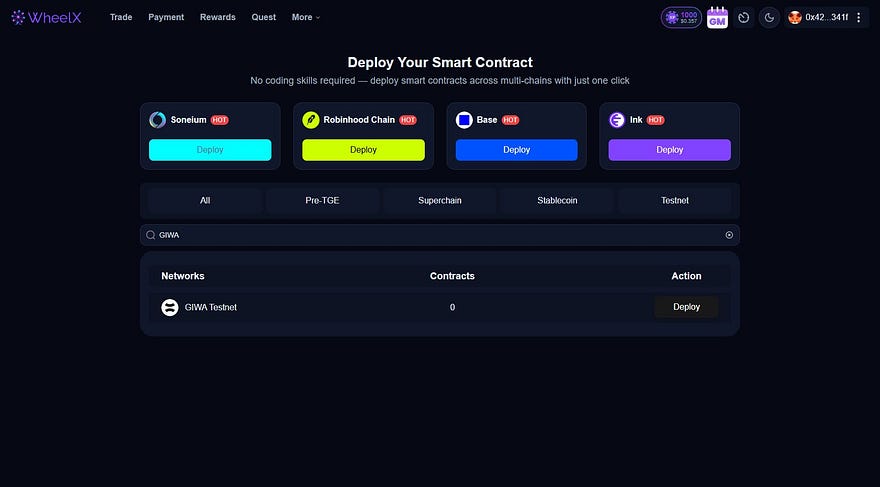
Use the search box and enter GIWA. The GIWA Testnet row should appear with a Deploy action. WheelX presents this as a one-click, no-coding deployment experience.

Step 4 — Start Deployment
Click Deploy on the GIWA Testnet row. WheelX prepares the transaction without requiring a Solidity file, source-code editing, Hardhat configuration, or custom calldata.
A real testnet transaction is still being created, so your wallet must authorize it.
Step 5 — Review and Confirm in Your Wallet
Verify that the network is GIWA Sepolia and the Chain ID is 91342. Review the gas estimate, then confirm only when the request matches the deployment you initiated.
Gas is paid with GIWA Sepolia test ETH. “Testnet” does not mean zero gas. GIWA’s own deployment guide also notes that contract deployment requires gas and recommends checking the network and transaction details before confirmation.
Step 6 — Wait for Confirmation
Keep the WheelX page open while the status shows Deploying. Do not repeat-click Deploy or approve duplicate wallet prompts.
If progress appears stalled, copy the transaction hash from the wallet, when available, and check the explorer before retrying. RPC or explorer indexing delays can make a valid transaction appear slower than expected.
Step 7 — Verify On-Chain
After WheelX reports success, open the transaction or contract in the GIWA Sepolia Explorer. Confirm the status, originating wallet, transaction hash, contract address, block number, and timestamp.
The explorer — not a loading animation or wallet approval — is the final source of truth for whether the transaction was included and a contract was created.

Looking Ahead
GIWA Mainnet is still under development, making GIWA Sepolia the current environment for builders and users to test contracts, wallet interactions, and network infrastructure without putting real assets at risk.
For WheelX, supporting GIWA Testnet demonstrates how one-click deployment can lower the technical barrier to early network participation. Users can move from faucet funding to an on-chain contract without configuring a development framework or writing deployment scripts.
The next step is not to speculate about future rewards, but to focus on verifiable activity: use official network parameters, understand each transaction, and confirm every deployment through the GIWA Sepolia Explorer. Any future mainnet support, incentive program, or eligibility criteria should be evaluated only after official announcements from GIWA or WheelX.
As GIWA continues developing its ecosystem, WheelX aims to provide a practical access layer that helps more users explore emerging networks through simpler, transparent, and verifiable on-chain actions.
About WheelX
WheelX is a cross-chain infrastructure platform designed to simplify on-chain interactions across multiple networks. From bridging and swapping to smart contract deployment and real-world asset access, WheelX empowers users to explore global financial opportunities in a seamless and efficient way.
🌐 Dapp: https://wheelx.fi/
💬 Discord: https://discord.gg/GaqW8QEVTF
📱 Telegram : https://t.me/WheelX_official
▶️ Youtube : https://www.youtube.com/@wheelxfi
📘 Docs: https://docs.wheelx.fi/
✅ Audit Report: http://bit.ly/3K5xwEA