How Arc, Circle, USDC, and WheelX Fit Together
September 4, 2026
Background
Circle provides programmable digital money, Arc provides stablecoin-native settlement, and WheelX connects that infrastructure to the wider multichain ecosystem.
Stablecoins are becoming more than assets used for trading. They are increasingly used as settlement infrastructure for payments, treasury management, foreign exchange, and onchain financial applications.
For this model to work at scale, the ecosystem needs several complementary layers. Circle and USDC provide programmable digital money and interoperability infrastructure. Arc provides a blockchain designed around stablecoin settlement. WheelX provides the cross-chain access and routing layer that connects users, assets, and liquidity across networks.
Arc: A Blockchain Designed Around Stablecoin Finance
Arc is an open Layer 1 blockchain developed by Circle for stablecoin-based financial activity.
Its architecture addresses several practical challenges faced by payment and financial applications.
USDC is used as Arc’s native gas token, allowing transaction fees to remain dollar-denominated instead of depending on a volatile network asset. Arc also offers predictable fees, deterministic sub-second finality, built-in foreign exchange capabilities, EVM compatibility, and optional privacy features.
These characteristics make Arc suitable for applications involving payments, FX settlement, tokenised assets, credit, and other forms of programmable finance.
Circle and USDC Provide the Monetary Layer
USDC is the monetary foundation of this infrastructure.
Issued by Circle and redeemable 1:1 for US dollars, USDC allows developers and businesses to use dollar-denominated value within programmable applications. Circle supports this through payment infrastructure, developer tools, wallets, smart contracts, and interoperability services.
Circle’s Cross-Chain Transfer Protocol, or CCTP, enables native USDC to move between supported blockchains through a burn-and-mint process. This reduces reliance on wrapped representations of USDC and supports more consistent movement across networks.
Arc does not replace this multichain model. Instead, it adds a stablecoin-native settlement environment to Circle’s broader infrastructure.
Why Arc Still Needs Cross-Chain Infrastructure
Even with a specialised settlement layer, users and liquidity remain distributed across many blockchains.
USDC holders may be active on Ethereum, Base, Arbitrum, Solana, BNB Chain, or other networks. Applications also need to manage different tokens, wallets, routes, liquidity sources, and transaction costs.
This means cross-chain access remains necessary.
The challenge is not simply moving an asset from one blockchain to another. Users also need efficient route selection, token conversion, liquidity discovery, fee comparison, and a simpler way to interact with several protocols.
Arc’s own documentation includes a cross-chain bridge quickstart, showing that interoperability remains an important part of accessing the network.
WheelX’s Position in the Circle and Arc Ecosystems
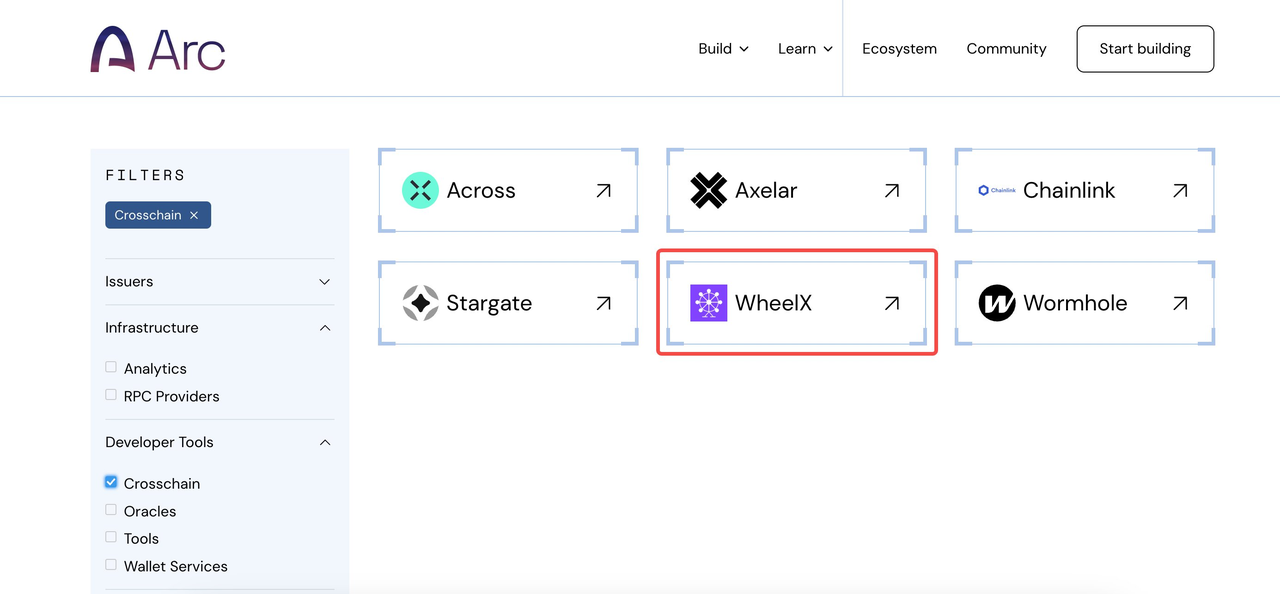
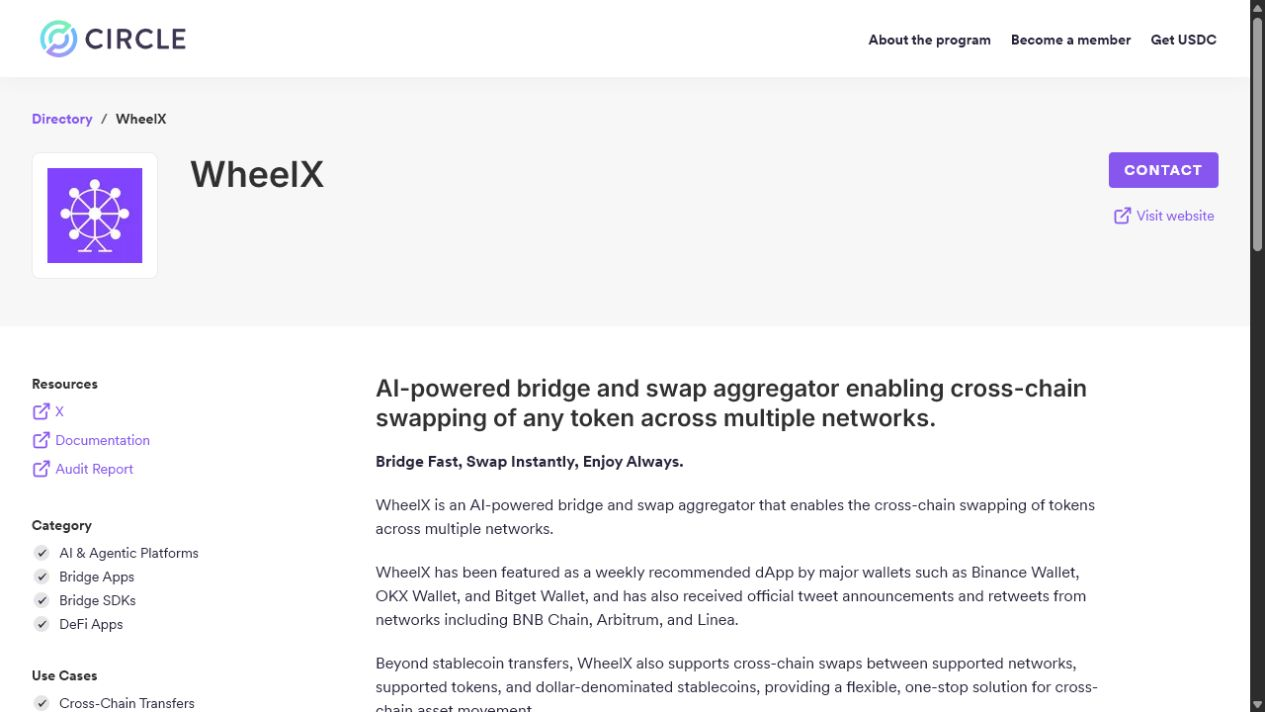
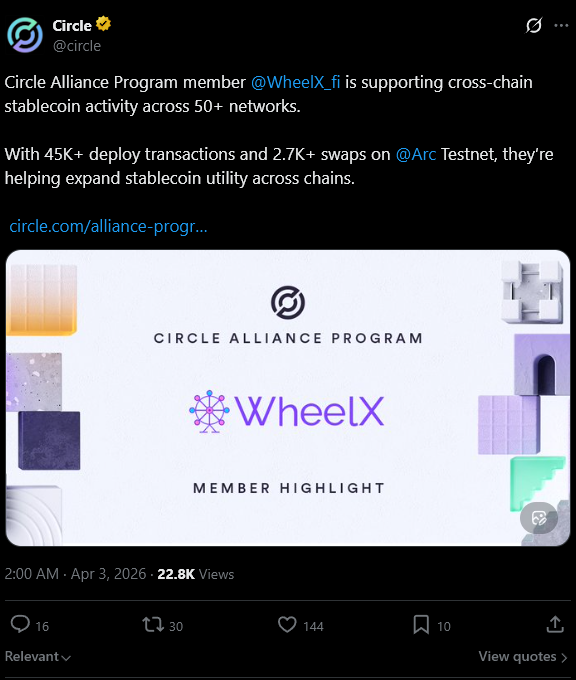
WheelX is listed in the official Circle Alliance Directory, with Arc included among its supported networks.
The directory categorises WheelX across bridge applications, bridge SDKs, DeFi applications, and AI and agentic platforms. It also identifies cross-chain transfers and token swapping among its use cases.
This reflects WheelX’s broader role as cross-chain infrastructure rather than merely a single bridge.
Through its user interface, WheelX helps users find and execute routes across supported networks. Through its API and SDK, developers can integrate bridge, swap, and cross-chain routing functions directly into their applications.
Within this structure, Circle provides the monetary and interoperability foundation, Arc provides the settlement layer, and WheelX provides access and routing across the multichain ecosystem.
The Circle Alliance Directory listing confirms WheelX’s presence in the ecosystem. It should not be interpreted as an official recommendation from Arc.
WheelX Data : Demand for Multichain USDC
WheelX’s internal activity data also shows existing demand for moving USDC across networks.
Across general WheelX activity during 2025–2026, standard or native USDC appeared on at least one side of transactions totalling $1,725,443.30 across 19,183 records. Of these, 16,493 records had an amount above zero.
Network attribution included:
- Ethereum: $991,551.51
- Base: $479,926.51
- Arbitrum: $180,402.21
- BNB Chain: $160,420.03
- Solana: $9,397.12
These network figures should not be added together because one cross-chain transaction may be attributed to both its source and destination networks.
Different-network transactions using standard USDC on both sides reached $25,605.10 across 434 records, including 391 records with amounts above zero. USDC.e was calculated separately at $1,792.46.
These are WheelX-wide figures for 2025–2026, not Arc-specific volume. They demonstrate that demand for USDC already spans multiple blockchain environments.
From Ecosystem Recognition to Practical Participation
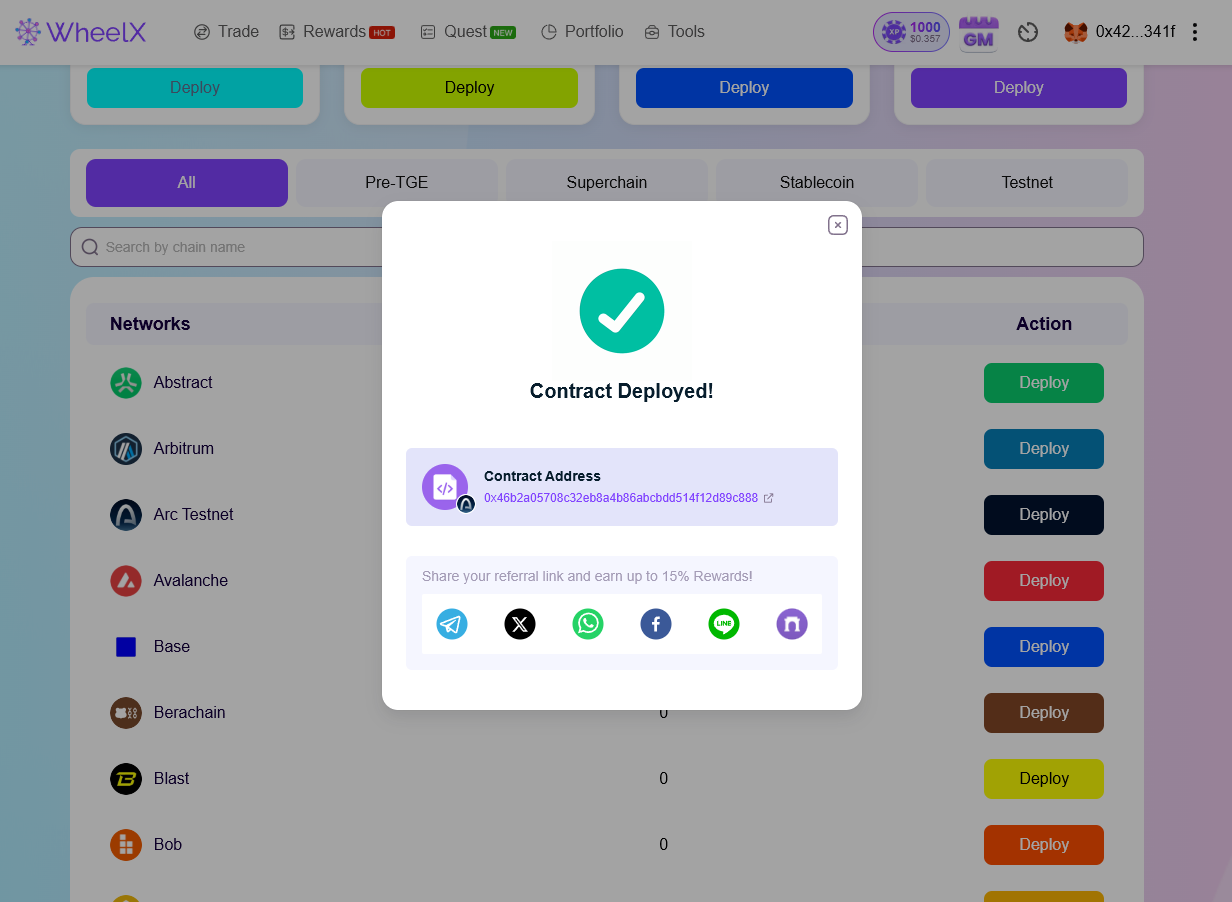
Users who want to explore Arc directly can follow the separate WheelX Arc Testnet tutorial.
The tutorial explains how to obtain testnet USDC from Circle’s public faucet and deploy on Arc Testnet through WheelX.
Looking Ahead
WheelX will continue supporting Arc through cross-chain routing, its user interface, API and SDK integrations, and simplified access for users and developers.
The objective is not to make every blockchain identical. It is to make movement between them easier.
Circle and USDC provide programmable digital money. Arc provides stablecoin-native settlement. WheelX connects that settlement layer to the wider multichain economy.
About WheelX
WheelX is a cross-chain infrastructure platform designed to simplify on-chain interactions across multiple networks. From bridging and swapping to smart contract deployment and real-world asset access, WheelX empowers users to explore global financial opportunities in a seamless and efficient way.
🌐 Dapp: https://wheelx.fi/
🐦 X: https://x.com/WheelX_fi
💬 Discord: https://discord.gg/GaqW8QEVTF
📱 Telegram : https://t.me/WheelX_official
▶️ Youtube : https://www.youtube.com/@wheelxfi
📘 Docs: https://docs.wheelx.fi/
✅ Audit Report: http://bit.ly/3K5xwEA